

A New Direction for Sustainable Life
We live in one of the most technologically advanced periods in human history.
We can communicate instantly with people around the world. We generate electricity from the sun and wind. We design buildings with systems thinking that use a fraction of the energy they once did. Artificial intelligence can answer questions in seconds, and scientists continue to make remarkable discoveries.
Yet despite all of this progress, many of our greatest challenges remain.
Climate change.
Water security.
Waste.
Housing affordability.
Biodiversity loss.
Rising costs.
At first glance, these appear to be separate problems, each demanding its own solution.
But what if they aren’t?
What if the greatest challenge of the 21st century isn’t a lack of technology?
What if it’s our ability to understand how everything is connected?
For generations we’ve been taught to break problems into smaller pieces. We study biology, economics, engineering and environmental science as separate subjects. While this approach has helped us make incredible advances, it can also hide the relationships between them.
A cardboard box isn’t just cardboard.
It’s trees.
It’s water.
It’s energy.
It’s transportation.
It’s manufacturing.
It’s labour.
It’s packaging.
It’s retail.
Eventually it becomes either a valuable resource or a waste product.
The same is true for almost everything we use.
Every product has a story.
When we begin to see those stories, our perspective changes.
Repair makes sense because we understand the value already invested in an object.
Rainwater harvesting becomes more than saving water however—it becomes part of a more resilient community.
Food scraps become compost instead of garbage.
Glass becomes aggregate.
Plastic becomes raw material for new products.
Waste begins to disappear because we stop seeing it as waste.
Instead, we begin to see resources moving through a living system.
Nature has always worked this way.
In a healthy forest there is no landfill.
The leaves that fall each autumn become the nutrients that feed next year’s growth.
Nothing is wasted.
Everything has another purpose.
Perhaps our communities have something to learn from that.
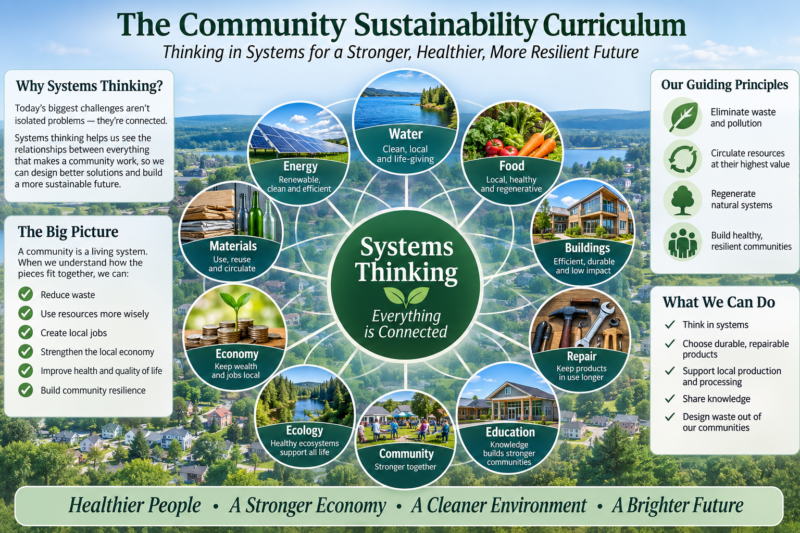
Over the coming weeks, I’d like to explore an idea that has guided much of my work over the years: systems thinking.
We’ll look at why repair matters, why local processing creates opportunity, how communities become more resilient, and why the circular economy is about much more than recycling.
Because sustainability isn’t about solving one problem at a time.
It’s about understanding the connections between them.
I believe that’s one of the most important skills we can develop in the twenty-first century.
Not just sustainability literacy.
Systems literacy.
Because when we understand how the pieces fit together, we begin designing communities that are healthier, more resilient, and better prepared for the future.
This is the beginning of that conversation.
Coming next in this series:
- The Circular Economy Isn’t About Recycling
- Why We Created Waste in the First Place
- Thinking in Systems
- The True Cost of Consumption
- Repair Before Recycling
- The Day Landfills Become Mines
Internal Links
- Sustainable Living Plan https://www.sustainablelife.biz/wp-content/uploads/2026/02/Diamond_Valley_Sustainability_Plan_2025-Copy.pdf
- Circular Economy Series https://www.sustainablelife.biz/category/circular-economy-series/
- Repair Café https://www.sustainablelife.biz/category/repair-cafe-trade-day/
- Rainwater Harvesting https://www.sustainablelife.biz/category/rain-water-harvesting/
- Renewable Energy https://www.sustainablelife.biz/category/renewable-energy-report-series/
- LEED Series https://www.sustainablelife.biz/category/leed-series/
- Community Air Quality https://www.sustainablelife.biz/category/air-quality-management/
- Story Map https://www.sustainablelife.biz/wp-content/uploads/2026/07/Community-Sustainability-Curriculum-e1784563381246.png
External Links
- Ellen MacArthur Foundation (Circular Economy) https://www.ellenmacarthurfoundation.org/
- Waters Centre for Systems Thinkinghttps://waterscenterst.org/
- Jeremy Rifkin’s Zero Marginal Cost Society (a worthy read) https://www.thezeromarginalcostsociety.com/the-book.html
Where We’re Going Next
This article introduces the Community Sustainability Curriculum.
In the coming weeks we’ll explore topics including:
- Systems Thinking
- The Circular Economy
- Repair Culture
- Water Literacy
- Energy Literacy
- Community Resilience
- Designing Waste Out of Communities
Each article builds on the previous one as we explore how healthy communities function as living systems.
Link
Systems Thinking https://www.sustainablelife.biz/category/systems-thinking/
“Sustainability grows when we share it.”
Discover more from Sustainable Life
Subscribe to get the latest posts sent to your email.